Have you ever had one of those weeks where you’ve had so much planned to do but by the end of the week, hardly nothing has been done?
Yeh, that’s one of the weeks I’m currently experiencing!
Here it is, a windy, chilly Thursday afternoon and I find that my sticky-note to-do list is still full of those task I wanted to get done on Monday! Gahh!! When did life get so busy and full?!
Anyway, let’s all calm down and allow me to use this small amount of time I’ve discovered this afternoon to write this (late!😁)* post and share it out to the world! Yay!
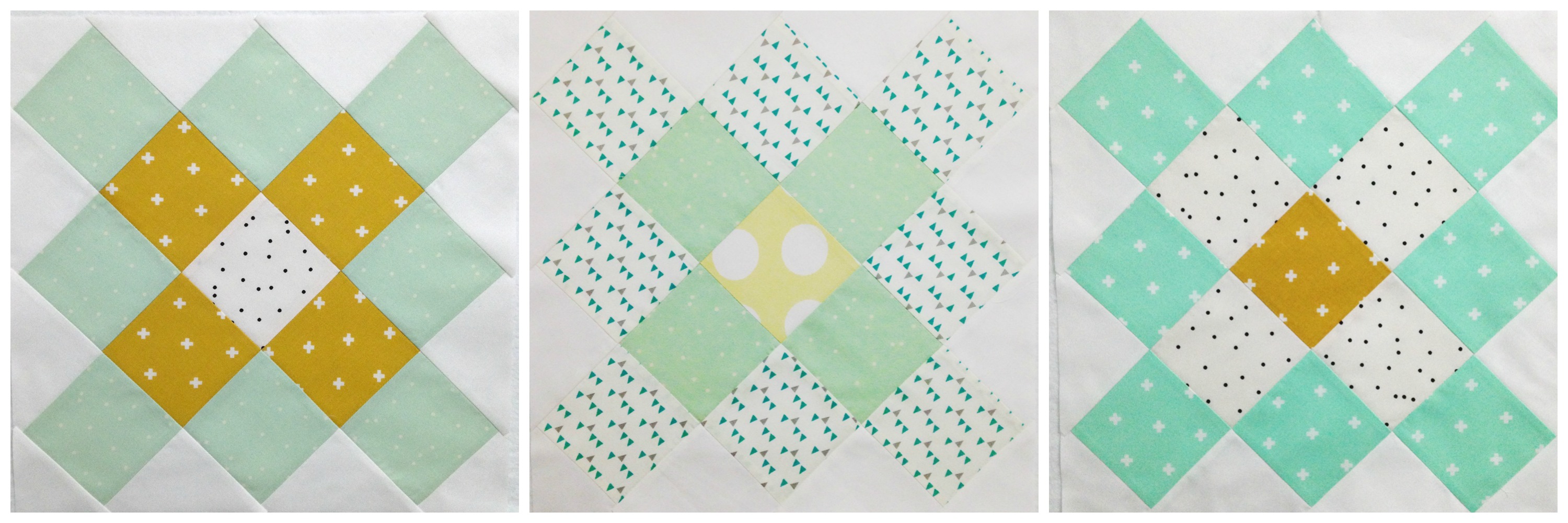
So quite recently, I’ve been asked by a lot of you to share the way, the method and/or the steps I take when matching fabrics for a block/quilt. I thought, ‘what a great idea! I’d love to share that with you all!’
So over the past weekend I made and uploaded the following video onto my YouTube channel, giving you an insight into how I do this when starting from just one main fabric. I decided to use three different print fabric examples in the video so that you could get the gist of how I do it!
If you have a particular method or style when it comes to matching your fabrics, please free to share it in the comments below!
Happy Matching, Friends!!
xx
*It’s okay, I know you all don’t mind that I write and publish out blog posts a little later than usual. And I know that you understand that life’s a busy ol’ mess and sometimes things don’t go according to plan. And you know, that’s okay, because there are situations in life that could be a whole lot worse than a busy and unstructed week. (Wow, I just got all like deep-thinkery and stuff about the situation and I scared myself a little bit… ohh… It must of been the 85% Dark Chocolate I nibbled on earlier. Which, may I say is horrible! Ergh! It was way too bitter! My disappointment levels are sky high right now!!! All I wanted was a nice little piece of chocolate with my afternoon cuppa, but instead was hit with a mouth full of saliva-sapping cold-hearted bitterness! 😭 Oh gosh, I’m rambling now…. I’m sorry. Must. Stop. Typing. Uhhh….yep…I’m going…I’m stopping…right now… uhh… Bye!)
(Well, it’s not really a secret. More of a thought, actually.)
I really loved having the opportunity to sit, write and share what had been happening in my Sewing Room last time and the response to that post was really encouraging and supportive! So because of that, I’ve decided to make this into a bit of a series to explore and to use as a ‘newsletter’ type thing, keeping you updated on things that I don’t share so much on YouTube, Instagram or any other of my social networky places. Sound good? Good!
And also, I like writing these types of posts as I love to be able to go back and read about what I was up to this time last year (yes, I am the type of blogger that actually likes to re-read what they wrote a year ago!), or to re-fresh my memory on the progress I made with quilts-in-the-making. I especially like looking back on posts about quilts that I give away, remembering what they looked like and re-living the thoughts (and struggles) I was facing when making them.
So, where to start off this time… Hmm…
Let’s start here!
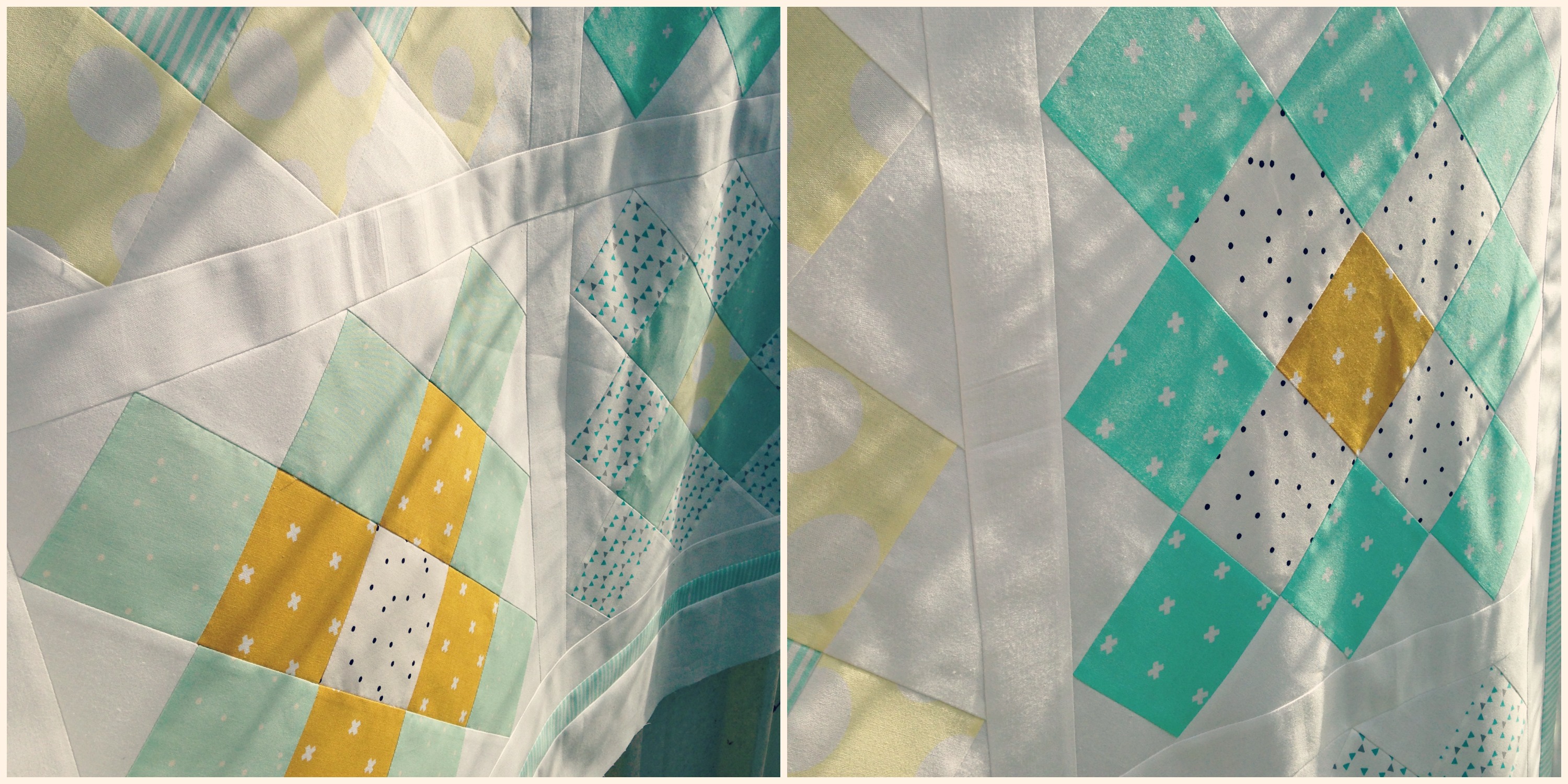
The other day I did share this completed quilt top on Instagram of one of the commissioned baby quilts I’m making for a friend.
I’m completely over the moon with how well it’s all come together! I absolutely loved how the fabrics shone, glimmered and danced in the winter sunshine and soft breeze on the day I shot these photos! It was a beautiful moment where my crazy quilt-nerdisms went into hyper-drive and I squealed and giggled to myself over its cuteness!
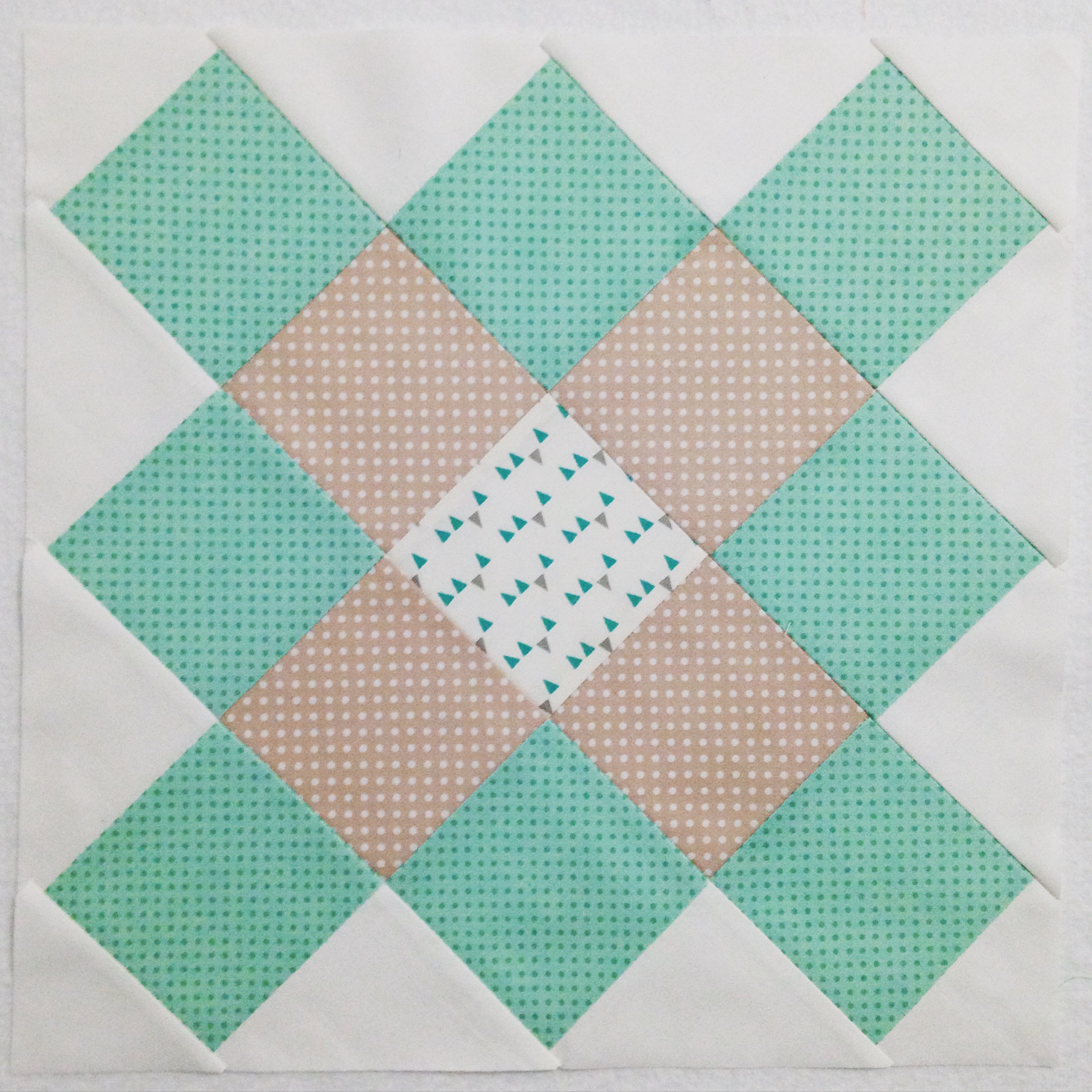
All up, I made five Granny Squares Blocks and had a hard time deciding whether to leave in the top left yellow spot block or this green spot block (ie. the first block I made at beginning!)
My First Granny Squares Block!
I ended up using the yellow spot block as it seemed to balance out all of the mint-green fabrics I had used. It seemed to give the quilt an over-all subtlety and softness that I really like.
Moving on to baby quilt number two. This time around I’m making a small bunch of 5.5″ Pinwheels using the left over 3.5″ squares I over cut for the Granny Squares Blocks. (They really are super adorable!)
I’ll also be using up any left over 2″ sashing I used on the previous quilt to sash the Pinwheels together. I think I’ll then add the same kind of border I did to the other one as well, but instead use the soft yellow spot fabric in place of the green strip border.
Yesterday afternoon I spent some down time finishing the piecing of the Pinwheels and then begun sashing the blocks together. I’m now at the stage where I can quite easily finish the quilt top in one afternoon or evening sewing session. (That’ll either happen today or tomorrow!)
I’ve set myself a goal to have both baby quilt tops finished for the start of next week so I can concentrate on getting them quilted. I think I’ll stick to some pretty basic quilting lines – nothing as intense as my Geo Dreams Quilt or Amelia’s Baby Quilt – as I think it’ll really compliment the softness and simpleness that each of these quilts already radiate.
(Here’s a piece of behind the scenes trivia for you: While piecing the Pinwheel Blocks together, instead listening to music like I usually do, I played season four of Adventure Time in the background! It helped tremendously to make those tedious steps of squaring up HSTs and pressing tricky seams a lot more bearable and fun! Math!)
Panda-Monium Mini Quilt by Fat Quarter Shop // IMAGE SOURCE
I’m dying to get stuck into making this sweet little mini but I just can’t… I already have my fingers in so many pies, so to speak, that I really need to calm myself down, put my patience pants on and begin it when I don’t already have so many other quilts to get finished!! (And seeing so many great versions of it being made on Instagram doesn’t help to calm my fever!!)
Oh, and I forget to mention – it’s a free pattern!! (Say what!?) Yep. A FREE pattern! I love a good freebie! Annndd, there’s also a YouTube tutorial on the Fat Quarter Shop channel showing you how to make it! How good is that?! 😀
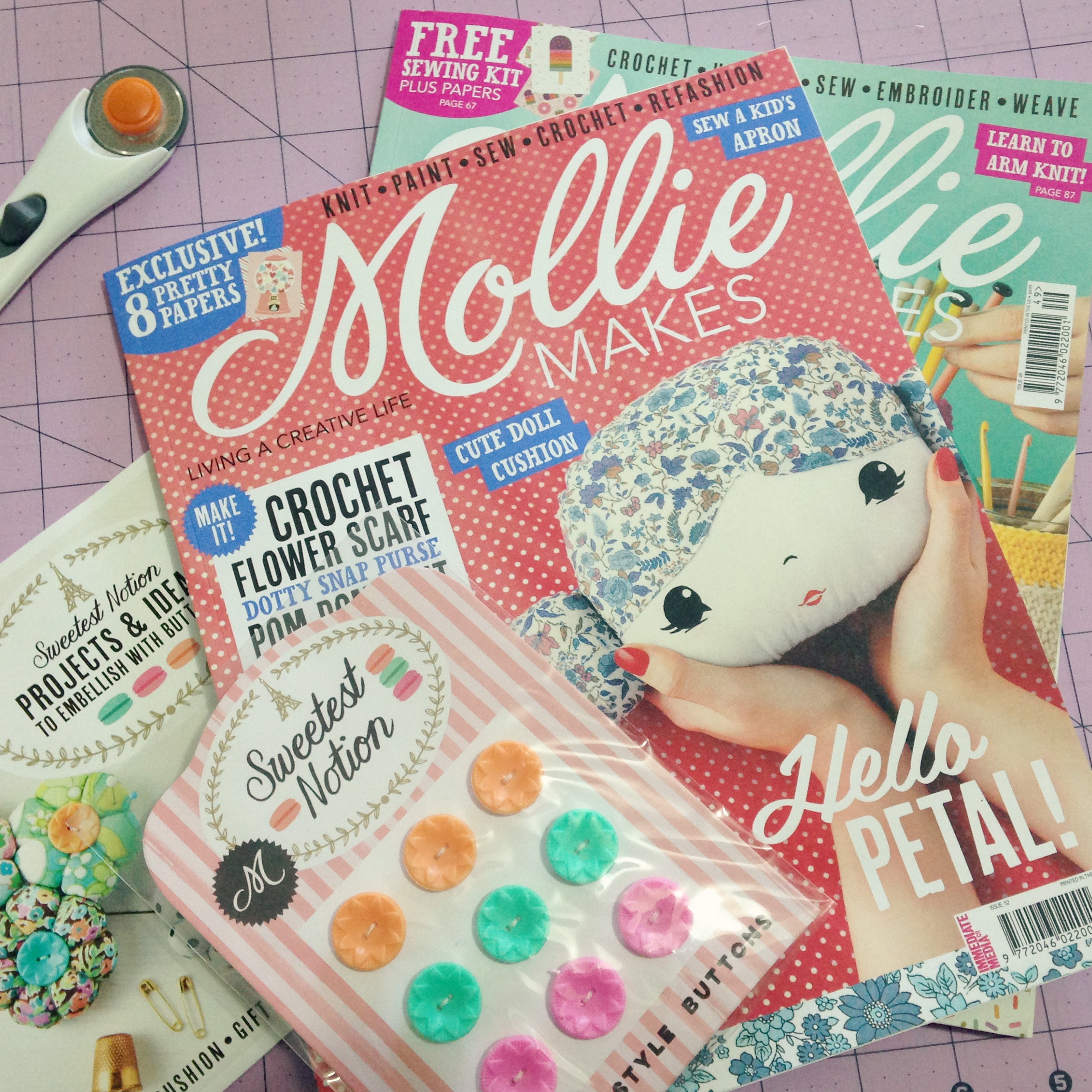
And lastly, may I just say, how awesome is the Mollie Makes magazine?!
If I could sum up everything that I want to be as quilter/sewer/crafter/whatever, this magazine is it! It’s 100% me but in pretty matte-pages form!
Although we’re a few issues behind here in Australia and you literally have to pay a small fortune for just one copy, it’s totes worth it, especially when you get cute freebies like pastel vintage buttons and DIY pincushion kits!!
+++
So that’s it this time ’round.
The weekend ahead, as usual, is full of sewing, creating, filming and editing!
I hope you’re weekend will be just as fun as mine!
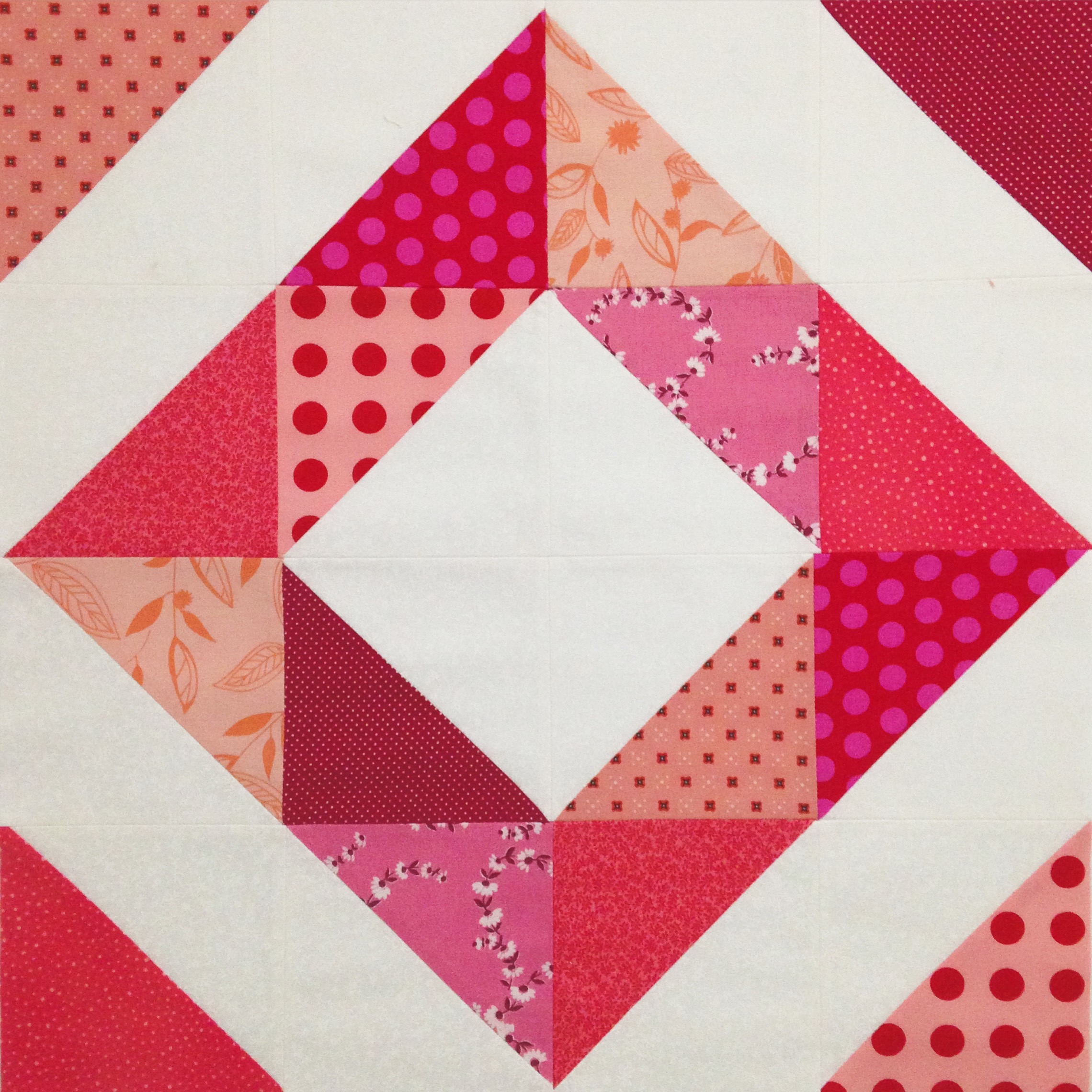
Here’s another quilt block tutorial coming your way! This time we’re looking at how to make the Diamond Square Block!
After showing this quilt I’m making for a friend for her birthday on Instagram and in the background of a few of my videos…
I’ve received so many requests from all you to show you how to piece this block/quilt together!
So here it is for you to make and turn into a lovely quilt, just like I have!
PS. I decided to make the following block using a range of pink printed fabrics, as I was so ready for a change from using so many blues!!
The deets…
This block is made up of x16 5″ HSTs and measures approx. 18.5″ squared.
Measurement & Cutting info:
You will need to cut:
– x8: 5.5″ white squares
– x8: 5.5″ squares from an assortment of print or coloured fabric (x1 of each)
A quick low-down of the steps to take:
1. Pair, sew, cut, press and trim the squares to make x16 HSTs.
2. Lay out the HSTs into the Diamond Square block design.
3. Sew the squares into four rows of four.
4. Press each seam on the back of the rows flat open.
5. Sew each of the four rows together to form the block.
6. Press and square up the block to finish.
For more detailed instructions on how to make this block, simply follow along with the steps in the video!
Diamond Square Block
+++
I can’t believe that some of you have already been sharing your completed blocks with me on Instagram (which I absolutely love, btw!), you’re creativeness and fabric choices always blow me away! If you would like to share your blocks/quilts with me, you’re always more than welcome to by tagging me on Instagram, Facebook and/or Twitter!
FYI: If your Instagram account is set to private and I don’t follow you, I won’t be able to see your photos when you tag me!! If this is the case, send me an email letting me know you’ve tagged me and I’ll do my best to find you on Instagram so I can give you a big fat LIKE and some wonderful words of positivity and encouragement!! 😀
…Are just a few words I would use to describe this sweet, sweet block!
Previous to this, I had never made a Granny Squares Block, whether in crochet or patchwork. It was those funny little triangle edges that always threw me off… I just couldn’t understand how this block was constructed to be able to achieve those odd angled squares and triangle-ly bits. It was only after a quick search on Pinterest, where I saw this simple picture, that I finally experienced that moment of: “Ohhhhh! That’s how you do it!!” It was legit a great moment and I immediately got into cutting and piecing my first block together…
My First Granny Squares Block!
I cannot express enough at just how quick and simple this block is to construct! It’s purely just piecing squares together (in the correct layout order), pressing the seams, sewing the rows together and then squaring the block up! So. Easy.
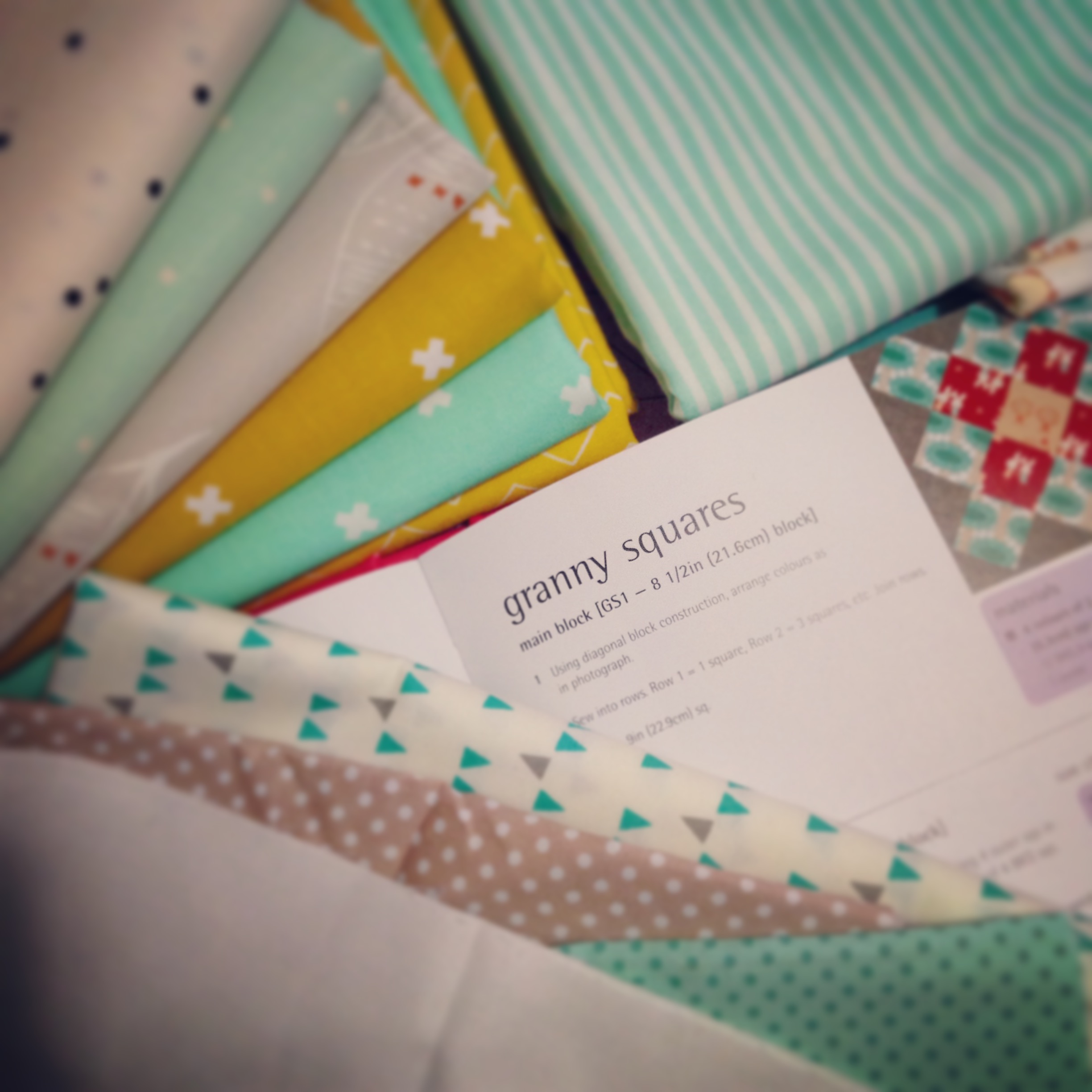
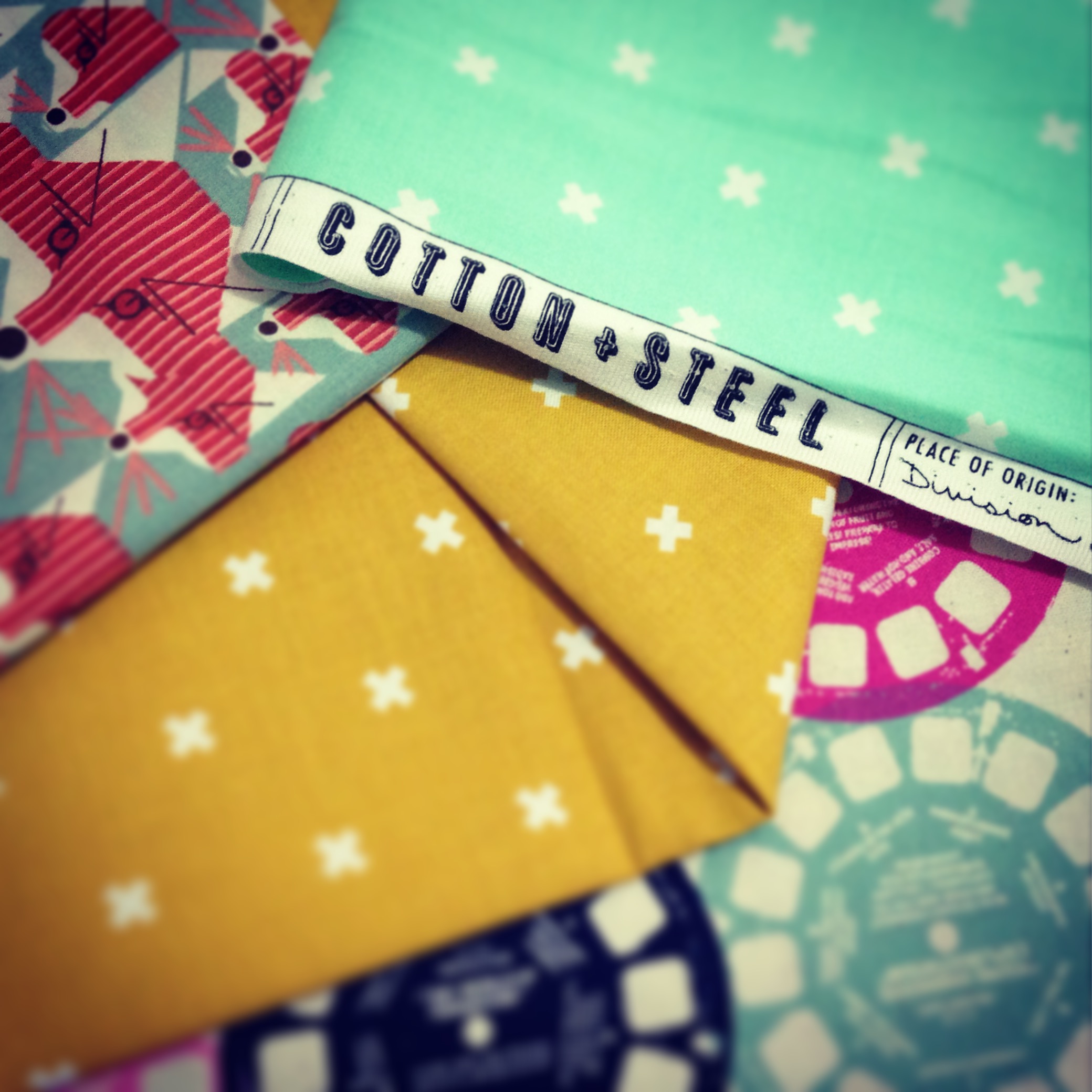
The reason why I’ve dived head-first into making Granny Squares is because of a commission I was recently ask to do for a friend. She has two friends who are expecting babies in the next few months and so asked me to make a baby quilt for each little bubba! This block will feature in one quilt and the other quilt is currently in the planning! Because both mums-to-be don’t know the gender of their babies, I’ve been sticking to a ‘gender-neutral’ colour palette of mint greens, creams, yellows and tans, with subtle, soft prints like polka-dots, little crosses and triangles. Some of the fabrics I’ve been using are from the Basics xoxo range from Cotton+Steel and the Hello Bear range by Art Gallery Fabrics. Both are such beautiful fabrics to use and blend in so nicely with each other throughout the other blocks I’ve made…
So smitten I was (and still am) by the Granny Squares block, I decided to make a tutorial for my YouTube channel on how to make one!
So here’s how you do it!
Measurements and Cutting info:
This block is made up of x25 3.5″ squares. (You can cut your squares bigger or smaller depending on how big you wish the final block size to be!)
The block is usually made using three to four fabrics. (I’ve chosen to use four.) But can also be completely scrappy if you wish!
Of each fabric you will need to cut:
~ x12 white squares for the background
~ x8 green squares for the outer section
~ x4 cream squares for the inner section
~ x1 mustard square for the centre
FINAL BLOCK SIZE: 13.5″ squared (approx.)
Fabric bought from Kelani Fabric Obsession
~ Natural Unseeded Homespun
~ Cotton+Steel Basic xoxo in Mint
~ Hello Bear by Art Gallery Fabrics: Firefly
~ Cotton+Steel Basic xoxo in Mustard
I hope you enjoy making this block just as much as I have and are able to create a beautiful quilt with them for someone special!
Today, I thought I’d take some time out and write up a bit of an ‘old school’ type post.. One where I share with you all of the going-ons that have been happening in and around my sewing room! Just like the good ol’ days!!
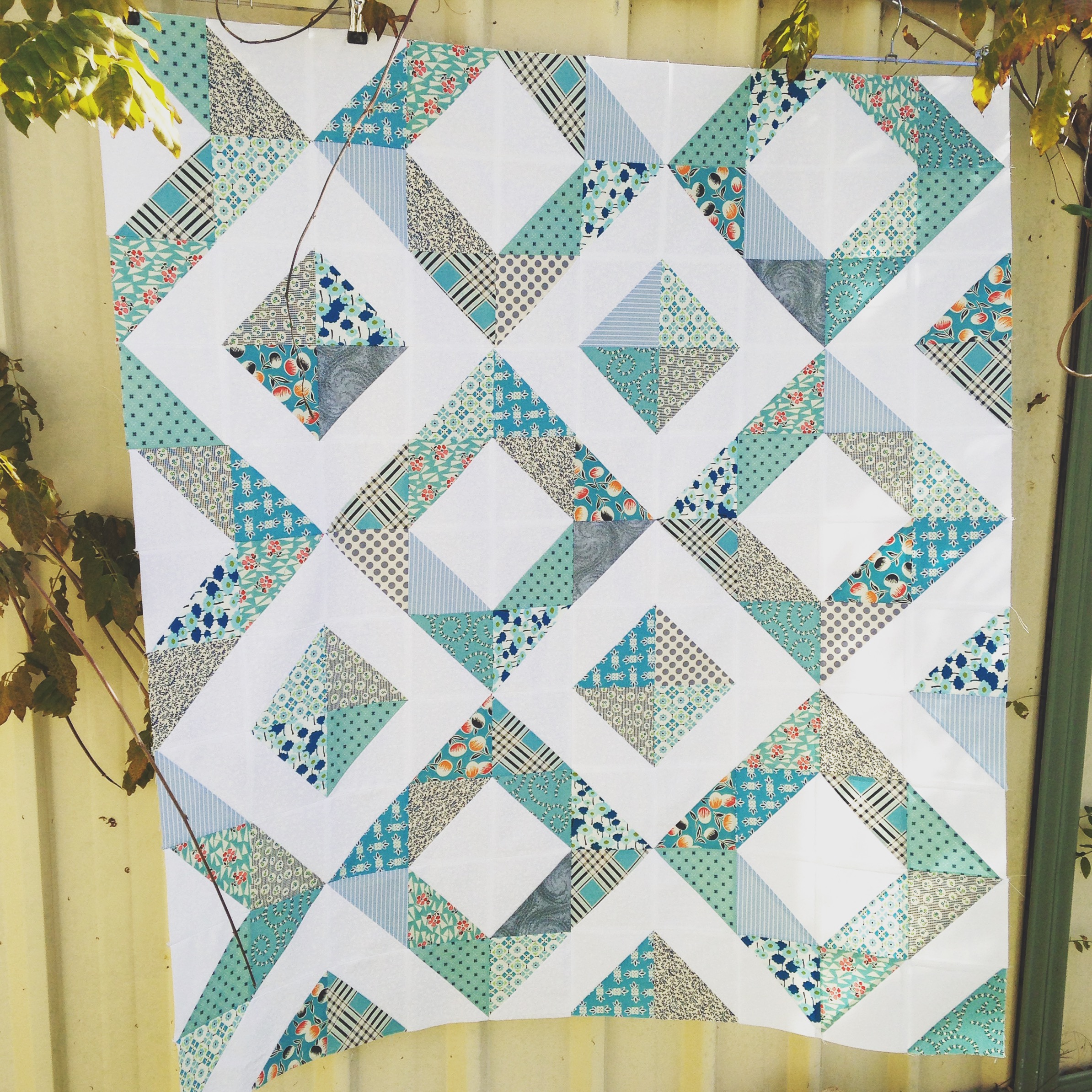
First up, I’ve been spending my down time making this quilt for a friend of mine who recently celebrated a very special birthday! (I’m saying no more on the subject, just incase they read this blog!) Typically, I missed the deadline of their actual birthday to have this quilt finished and gifted to them, but you know, better late than never!
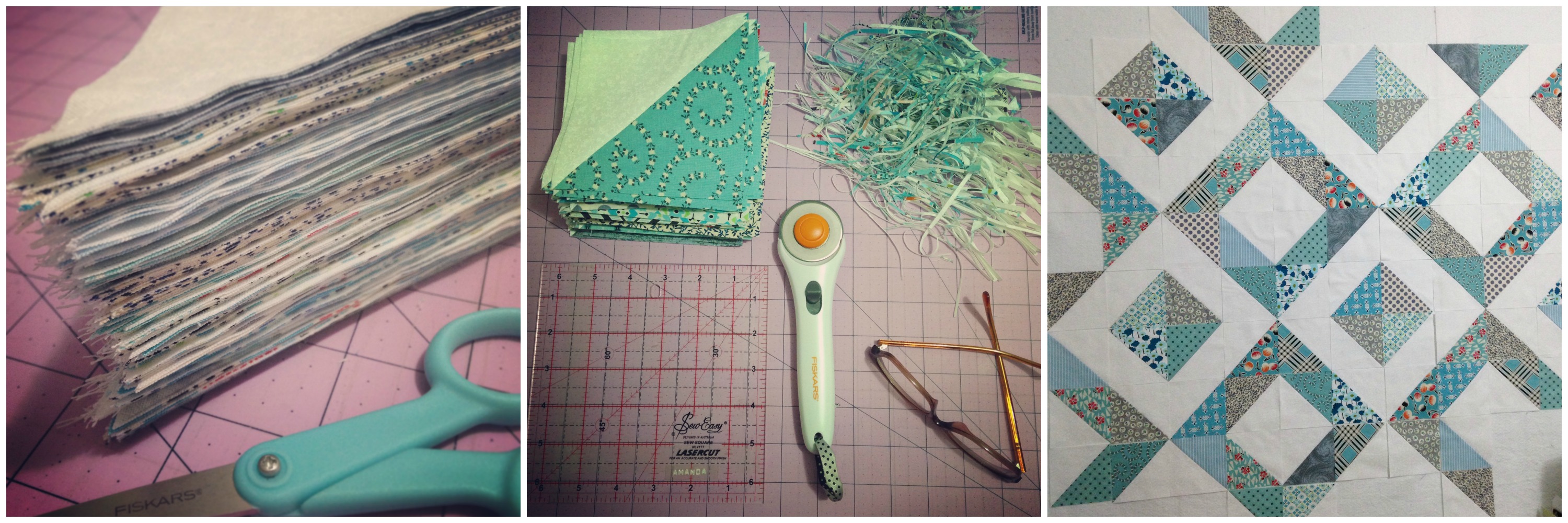
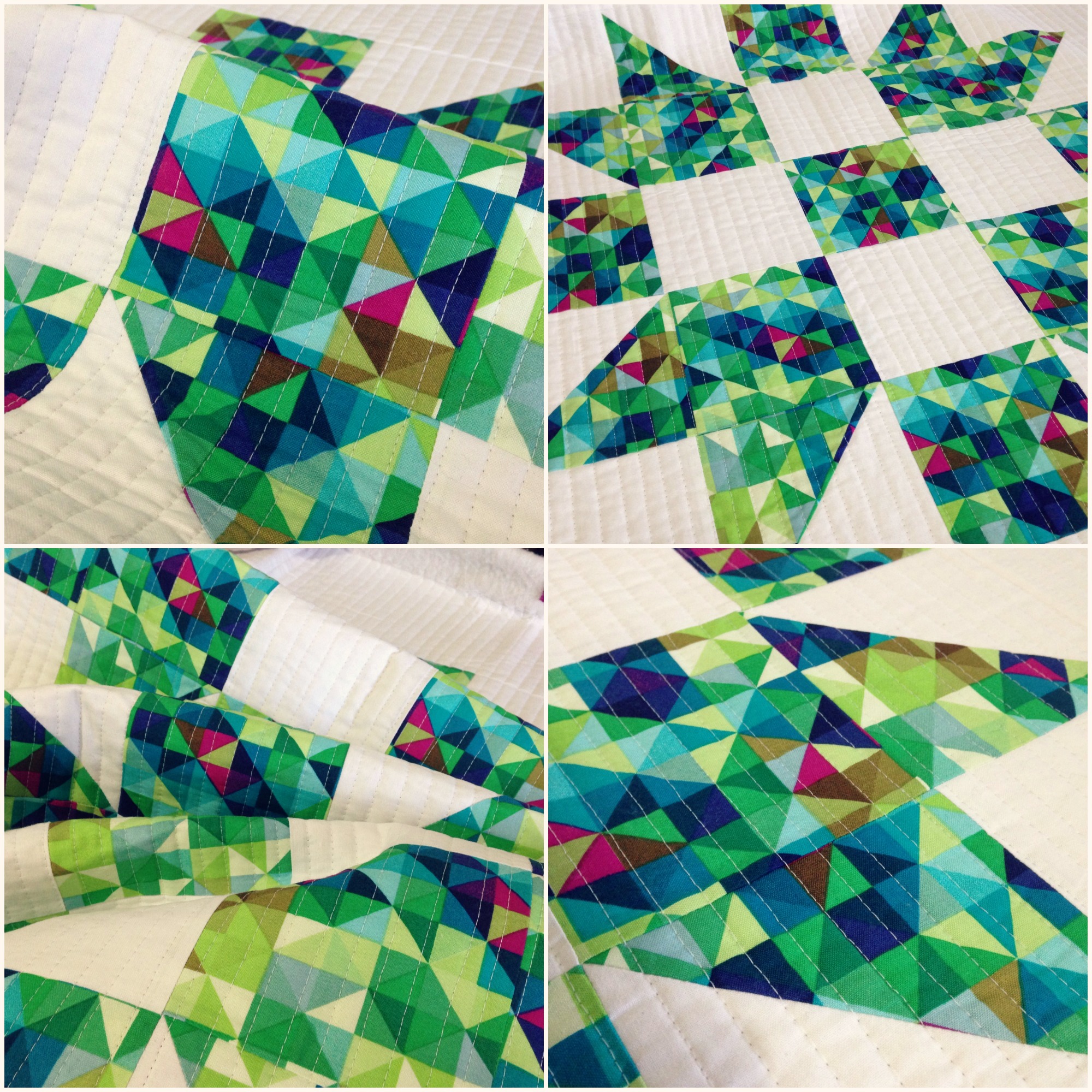
I found the inspiration for this one on Pinterest (where else!). The picture hit me straight in the face and I knew instantly it was perfect for this occasion! The recipient of this quilt loves the colour blue, so I riffled through my stash and found a mish-mash assortment of beautiful blues and mints with a mixture of prints, directions and values that would help add interest and movement to the quilt. I then paired these with a crisp white-on-white print fabric that make all of the blues pop and sing! All up I think I made about 120 5″ HSTs… I do love making HSTs but sometimes the monotony of trimming can be draining and painful! But after numerous cutting, piecing and trimming sessions, the time came to place the squares into place onto my design wall. I did this with no particular plan. I simply just placed them up ensuring similar prints and colours weren’t placed too close to one another. This did take a lot of back-and-forthing to ensure everything was working harmoniously!
The way I chose to piece the quilt top was an odd and very laborious one. I literally pieced the quilt top together one square at time… What I did was divide the quilt into quarters, pieced each one together and then brought them all together to complete the quilt top! It may not seem that tiring, but by doing it this way, I was forced to press every single seam on the back flat open! It wasn’t fun and it slightly took away the fun and excitement of making this quilt. But hey-ho, I pushed through it and got it completed about two weeks past its due date! Oh dear!
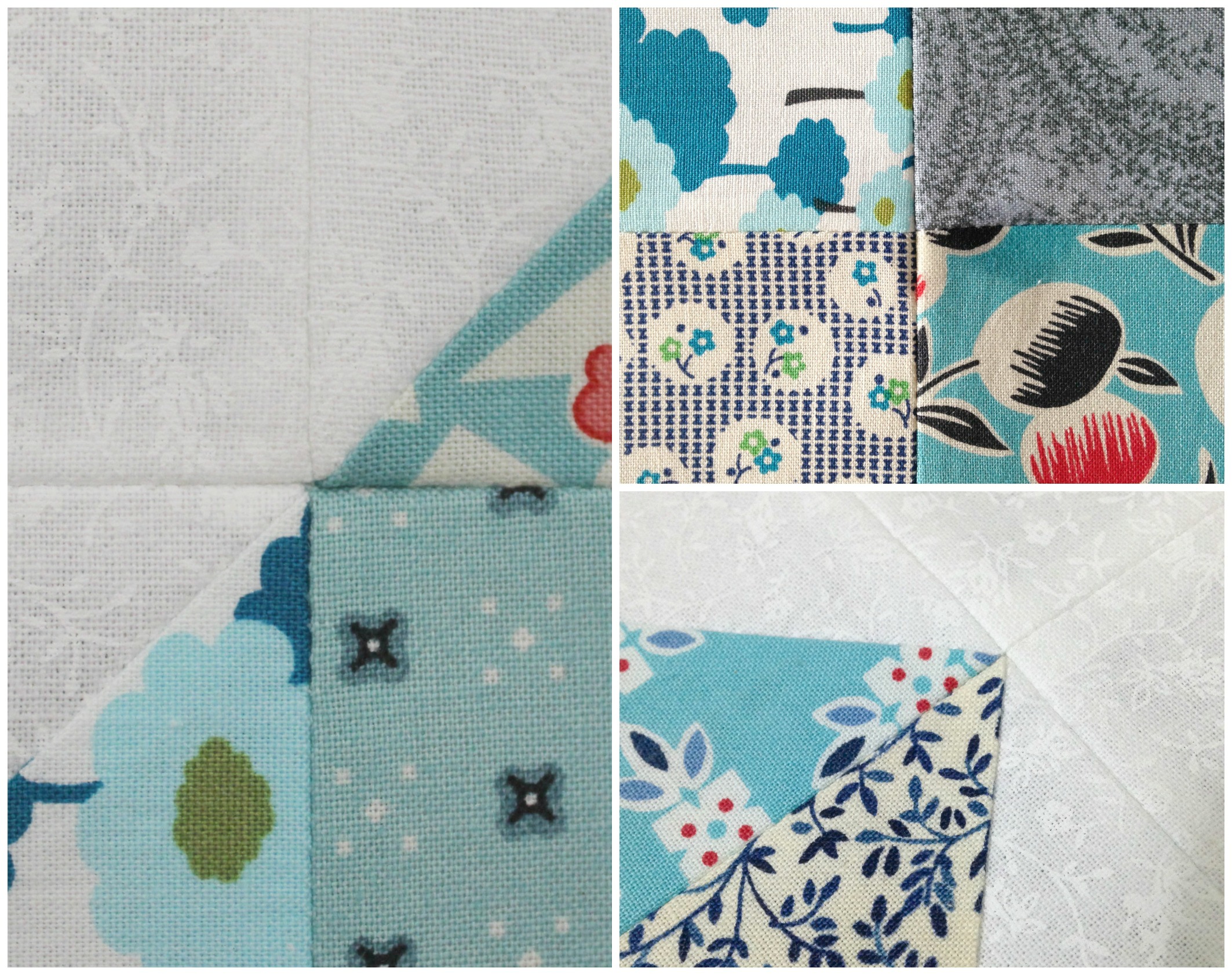
However I must say, by doing it that way, I had so much more control on getting the points of the triangles sitting perfectly together! I don’t think I’ve ever been able to get such perfect point matches and seam nests/joins in any other quilt I’ve pieced! Some of these beautiful joins just simply take my breath away!! So now I have the quilt top hanging to the right of me whilst I find the perfect backing for it and muster the enthusiasm to baste it! I’ll keep you updated once I’ve basted it and starting the quilting!
+++
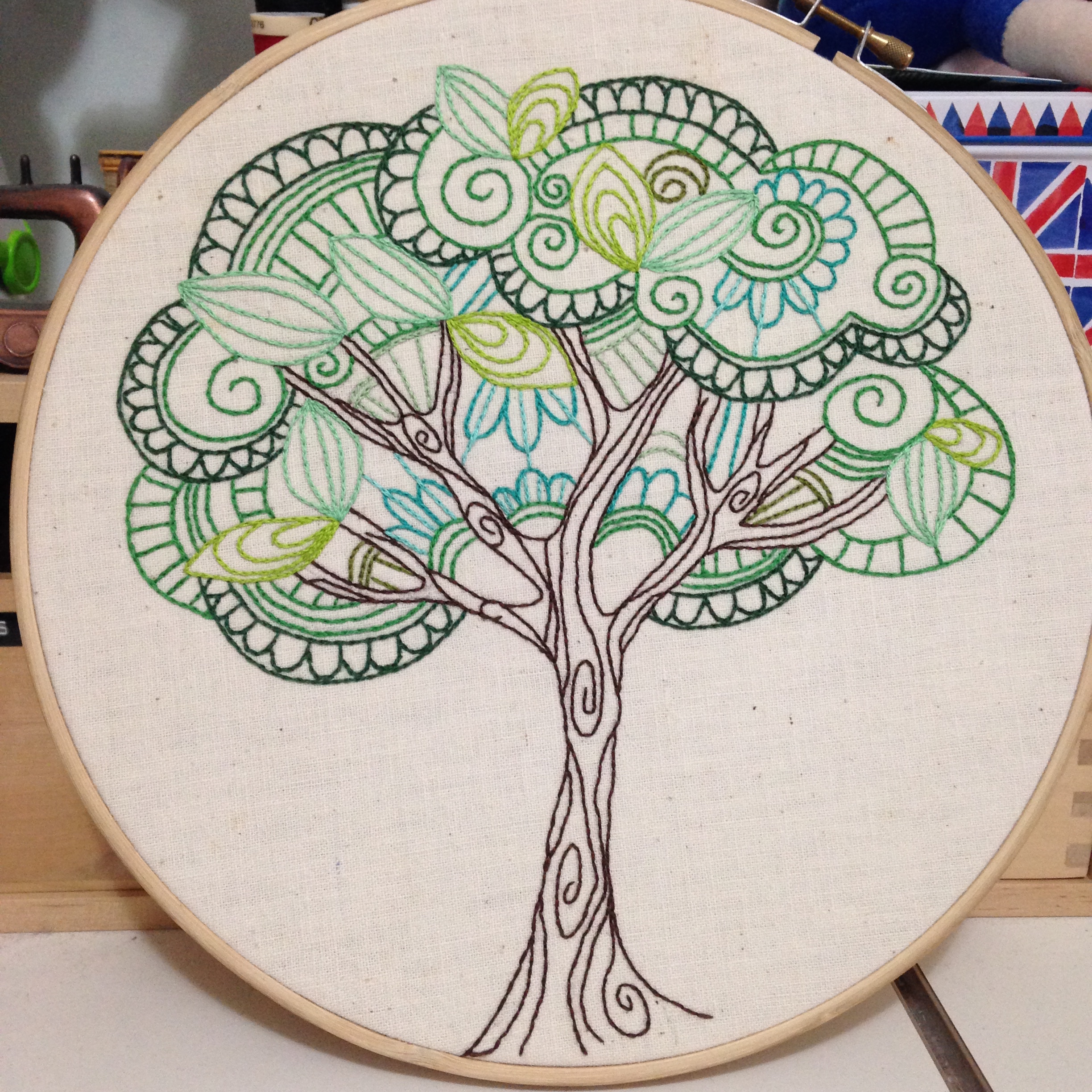
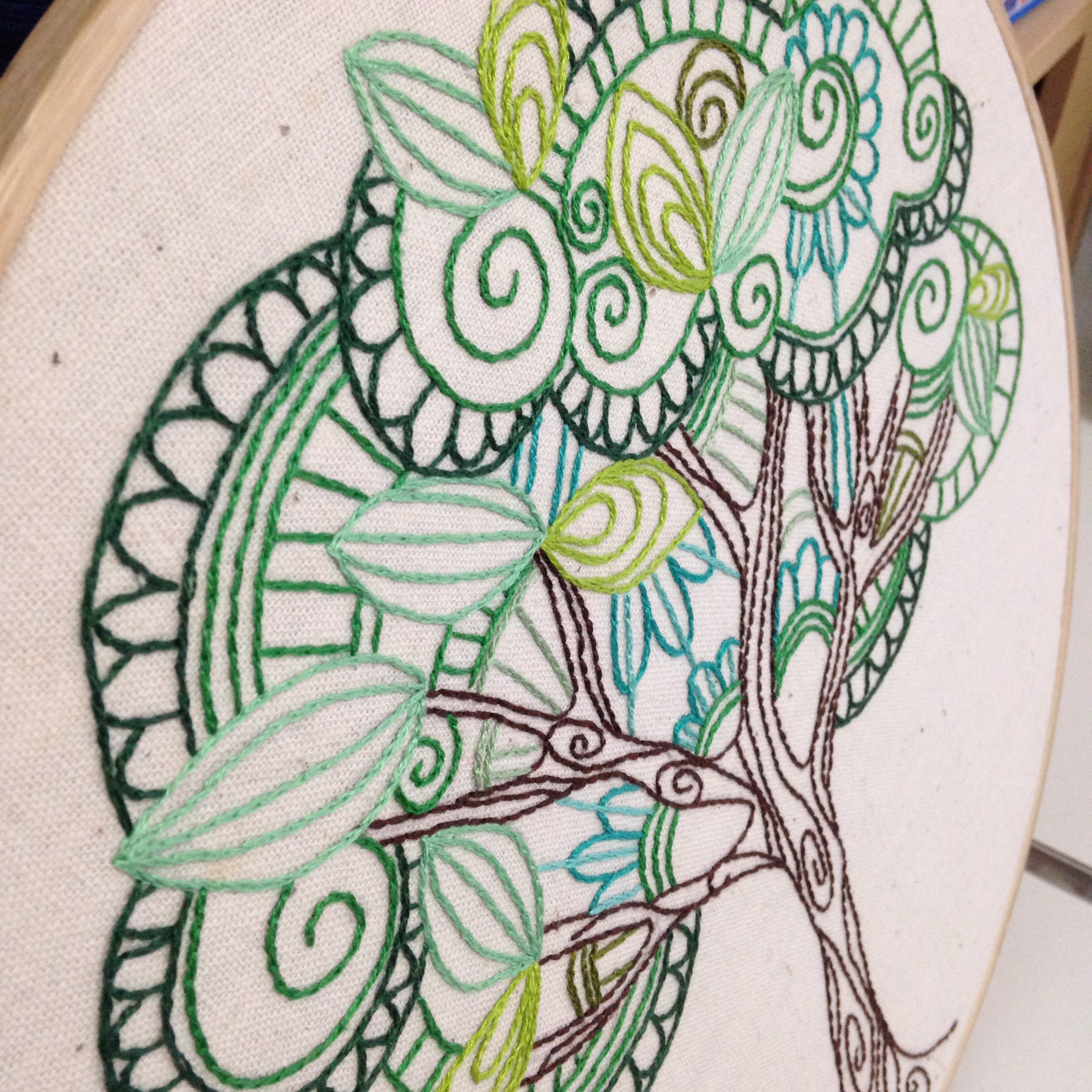
Next, I finally managed to finished my Tree embroidery that I took away with me while on holiday in Fiji! I’m not really sure why it took me so long to finish as I only had a few little areas to fill in to say that it was completed! I did share the finished result on my Instagram, but here it is again if you missed it, plus another showing the details…
Another thing that’s been revolving and considered in my sewing room is the decision to open my own Esty store! I’ve sold things I’ve made online before – for quite a few years actually – but wanted to find and use a new platform that would be and is more accessible to international shoppers. From what I’ve heard, Etsy has a pretty good reputation and is trustworthy and well known worldwide, so I thought I’d give it a go and see what happens!
At the moment, I haven’t anything for sale yet as I’m still at the planning stage of figuring out shipping rates, packaging and what it is I actually want to sell in my shop. I have a few quilts that I’ve made (or are half made atm!) that I would like to sell as well as some embroideries (possibly framed; still figuring that out!) and a few other things that I’ve made in the past that have sold well.
So stay tuned, things will be up and running fairly soon! (Hopefully!)
+++
Ooo!! Exciting times are ahead here in Sydney! The craft and quilting communities are getting ready for the Craft & Quilt Show to open next week!! Wheee!! This is like our version of QuiltCon or Quilter’s Market, where you get to explore, buy and be inspired by what’s new in the crafting and quilting worlds!
Also at the show they have the Sydney Quilt Show on where they display all of the quilts to be judged for Best in Show and other awards for 2015. I’ve entered in quilts over the past two years, but decided not to enter this year for a few different reasons. But I’m excited to see what the quality is like this year. The quilts last year were the best I’ve seen yet!
+++
And speaking of quilts and fabric and all good things, I recently went on a bit of a splurge on one of my favourite online fabric stores, Kelani Fabric Obsession! Every time I click onto that website, there’s always something new and beautiful to tempt me to buy and I sit there trying to justify why I need it in my life!
This time around, I did have a few good reasons why I needed to purchase some new fabrics… The first is a commission to make two gender-neutral baby quilts for a friend who has two girlfriends expecting! I love, love, love making baby quilts, so I said yes and immediately began planning what I would make! So half of the fabric I bought are to use in those two little quilts, while the rest of the order is to be used to make some special projects for my Esty shop! I’m so excited to get into them and get making some beautiful things for you all!
Oh, and I almost forgot! I uploaded a ‘Haul’ video on my YouTube channel over the weekend showing you everything I got!! If you would like to watch that, click right here!
+++
And finally the last thing I wanted to share with you is something I saw on Instagram this morning. It was a pledge created by Amy Gibson from the blog, Stitchery Dickory Dock. Called the ‘The For Keeps Pledge’, she encourages us quilters to pledge to keep the art of quilt making joyful, soulful, non-boastful and enjoyable! To see the pledge in full, click here to go to the blog post she wrote about it! I think it’s such a great concept for all quilters to focus on and work by, especially for me as I share so much of what I do online and with others.
+++
So that’s the end of the update! There is still so much to share with you but all in good time… 😉
What a wonderful day! You wanna know why? Cos it’s the final step in finishing our quilt!! Yay!!
In part six, we find out how to make and attach a quilt label so that we can officially say that our quilt is finished!
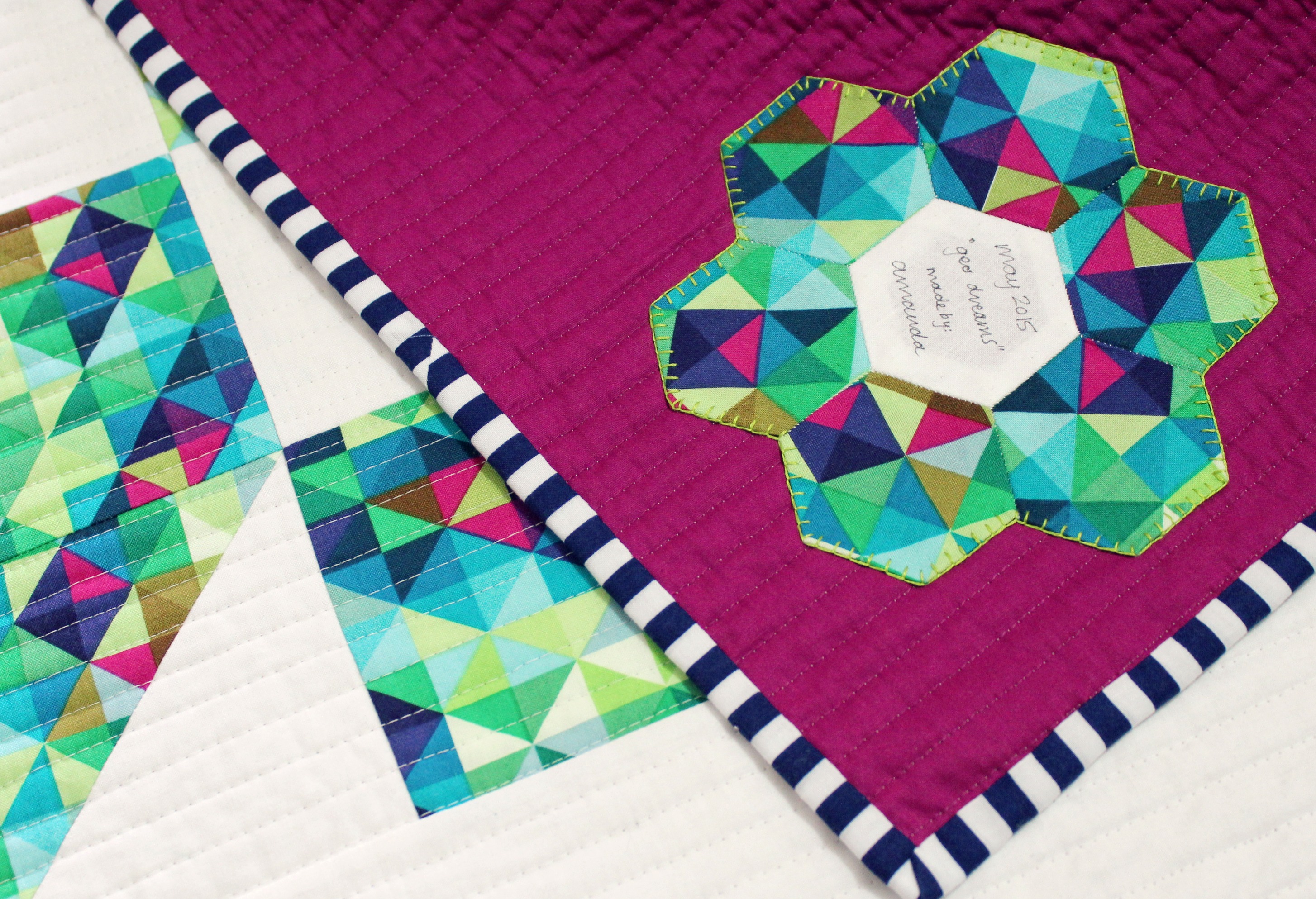
I think it’s super important to take time at the end and document all of the crucial details of the quilt in a label. It’ll serve as a great reminder of when the quilt was made, by whom it was made, for who it was made for as well as documenting the name of the quilt!
And the official name I’ve called this quilt is: Geo Dreams!
Geo Dreams Quilt Label
If you want to know a little bit more about quilt labels, how to make them, what to write on them along with the best ways to attach them to a quilt, I made this video and wrote this blog post about it!
As always I encourage you to make and attach your quilt label in the way that you know best and using a method that you find the easiest and/or most successful. You are always more than welcome to use my way as guide or for inspiration! If you would like to make your label as a hexie flower the same as mine but don’t know how to make them, here are two super-early videos I made showing you how to make hexies and then sewing them into a flower…
Because this is the final part in my QAWM series, the full pattern is now available for you to download, print and share with your quilty friends! Yeah!! The link to this at the top of this post… (PS.Let me know if there are any typos or mistakes – it’s always best to get a second opinion about these things!)
Thank you so much to all of you for participating and supporting me in this series! Your words of encouragement and excitement has made all of the hard work I put in totally worth it!
Thank you, thank you, thank you, thank you, thank you!!!
Although the series is at an end, please keep sharing with me your photos of your finished blocks, quilt tops, quilts or any of the stages you’re up to! Feel free to tag me on Instagram or Twitter at @3and3quarters, send me an email or share them on my Facebook page!
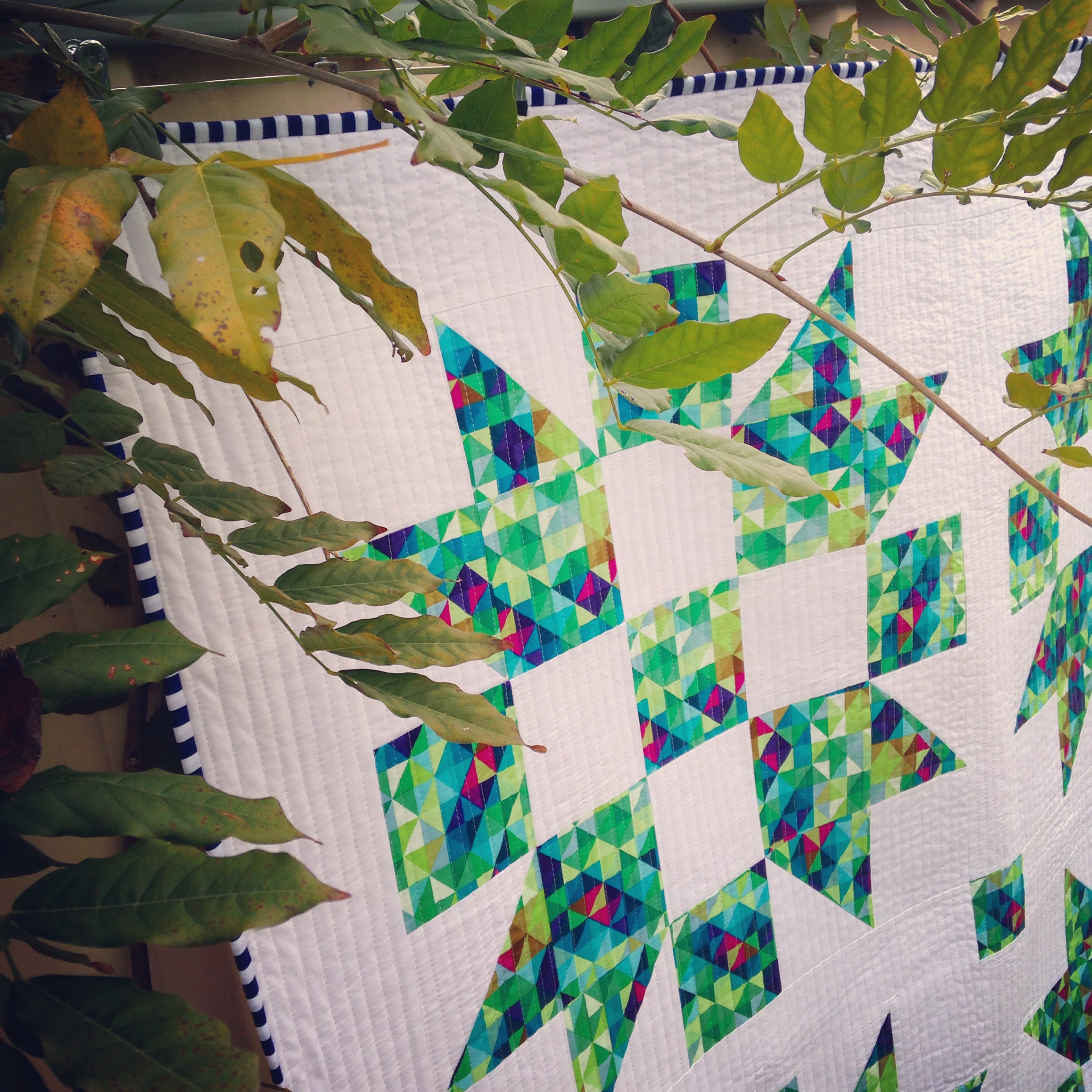
I’m going to leave you with a few of my favourite photos of the finished quilt I took in our backyard a few days ago…
Way-hey! We’re so close to the end of this series, with only one more installment to go after this one! Where has the time gone!
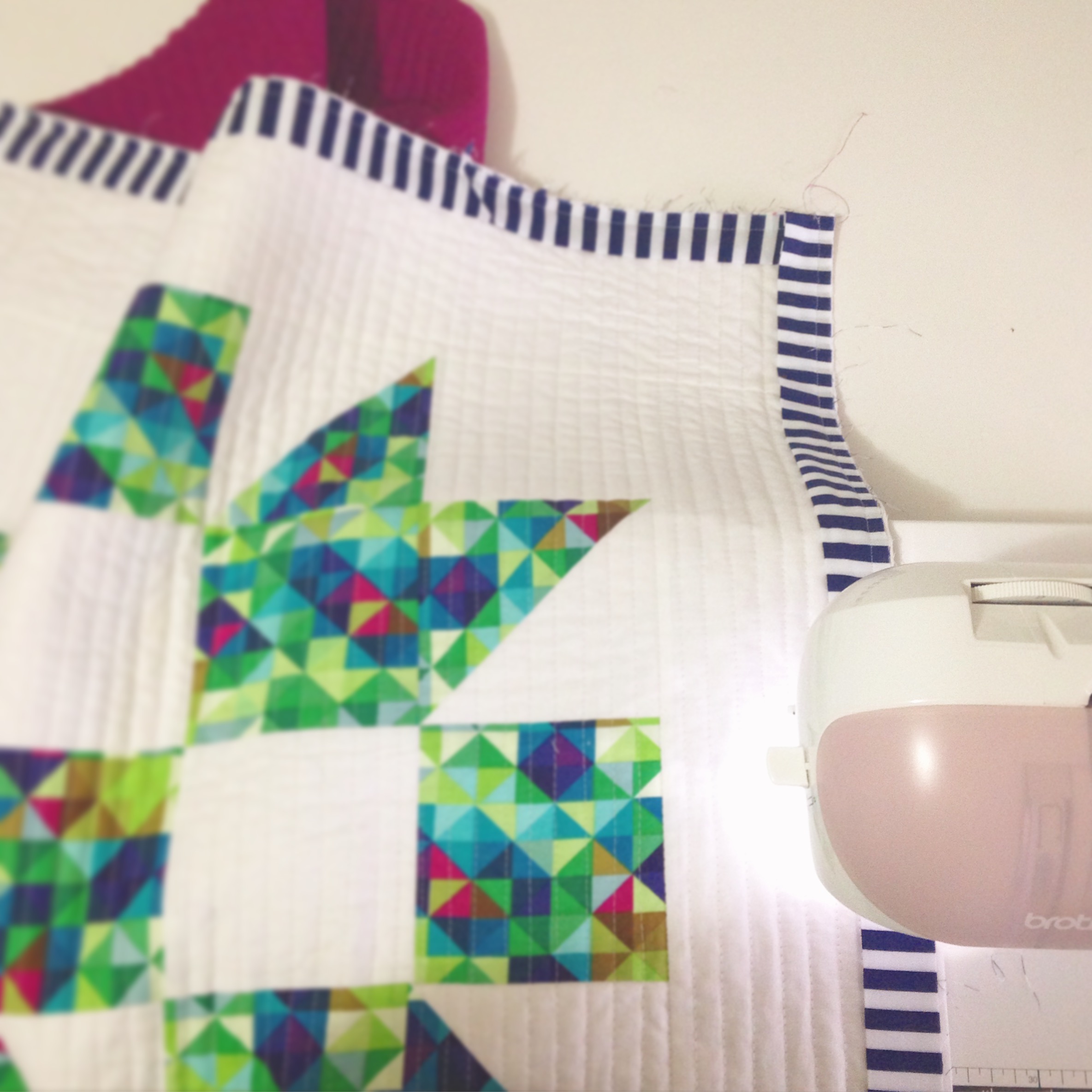
So in part five, we’re looking at how to make and attach a ‘cheat’s binding’ (that is: Straight-Grain Binding) to the raw edges around our quilt using sewing machine and hand sewing techniques!
TBH, making and sewing the binding is my favourite, favourite step in quilt making. After sewing it on with the machine, there’s just something so calming about sitting down with your almost-finished quilt and adding an element of hand sewing to it. It’s almost like that last finishing touch of colourful sprinkles on a pretty birthday cake before delivering it to the table to be devoured by hungry party guests. It’s like your last touch before you can almost let it go…
Wow, where did that deep-and-meaningful thought come from…?? Ooo…?!
Anyway…
As always I want to encourage you to make and attach the binding to your quilt in the way that you know best and using a method that you find the easiest and/or most successful. You are always more than welcome to use my way as guide or for inspiration! And if you do chose to follow my method, you’ll find all of the measurement and cutting info as well as a quick walk through of the steps to complete this stage in the pattern sheet linked above!
I always love it when you share with me your finished blocks, quilt tops and quilting! Feel free to tag me on Instagram* or Twitter at @3and3quarters, send me an email or share them on Facebook!
*FYI: If your Instagram account is set to private and I don’t follow you, I won’t be able to see your photos!! If this is the case, send me an email letting me know you’ve tagged me and I’ll do my best to find you on Instagram so I can give you a big fat LIKE and some wonderful words of positivity and encouragement!! 😀
So don’t forget to join me for part six, where we’ll go through the last step in making our quilt – the quilt label! And then…our quilt is officially finished!!! YAY!
Welcome to part four of my QAWM series! If you’re playing along at home, we’re now up to the stage where we are ready to quilt our basted quilt!
Over the past three parts to the series, I’ve been writing up a pattern/info sheet for you to download and print off… This time around, I’ve decided to put all of the information, tip, tricks and ideas for quilting in a blog post!
So let’s start off with the three main ways you can quilt your quilt:
The first is the most traditional way – hand quilting. This is a form of quilting where you sandwich your basted quilt into a large hoop, usually wooden that can some times be attached to a frame. Then using a short hand-quilting needle and waxed or non-waxed cotton thread, you sew a short running stitch through all three layers of the quilt. The technique takes quite a lot of patience and practice to get used to and can take up a lot of time, depending on the size of the quilt and the design you plan on quilting.
Another way would be to simply quilt on your own domestic sewing machine. The way you choose to do this is completely up to you! You can stick to straight vertical lines like I have or even explore Free-Motion Quilting where you lower the bottom feed dogs on your machine and move the quilt top in any direction you like using an embroidery/darning/spring-loaded foot! This form of quilting can also be known as ‘stippling’ and can be a little tricky to master! My advice would be to practice on some scrap batting and fabric to get a feel of the motion and direction before trying it out on your quilt.
The third way to get your quilt quilted would be to take it to a long-armer. This form of quilting is seen as a more ‘professional’ way to finish a quilt, with the end result looking absolutely beautiful, clean and perfect! You can usually find long-arm quilting services at your local quilting store or you can find a private quilter in your area.
Personally, I prefer to quilt my own quilts. The reasons for this are:
1. I have a fairly limited income and so can’t quite afford to pay someone else to quilt my quilt.
2. I’m a control freak and love that I have free reign on how I get to quilt.
3. I love the romance of my quilts being purely made by my self. That my hands, my heart, my efforts and my time, with nobody else’s, have constructed and finished a quilt. Sometimes this notion can come back and bite me in the butt – especially when time is a major factor – but on most occasions, a huge rush of accomplishment crashes over me and every gruelling, challenging and sometimes soul-changing step is totally worth it!
Okay, let’s now move onto how I get my sewing machine ready to start quilting. (Obviously, this information would only be relevant to those of you who wish to quilt their own quilts!)
– First, I change the foot on the machine from my 1/4″ foot to a walking foot. A walking foot features a set of ‘feed dogs’ that work together with the feed dogs on your sewing machine to help feed all three layers of your quilt through the machine all at once. The foot prevents the top layer of the quilt from moving forwards, keeps stitches even, stops the layers from puckering and it creates a smooth surface for you to quilt over.
– Next, depending on the last time I changed my needle, I’ll replace and put in a new sharp needle. I usually use a 90/14 universal needle as I find them to be the perfect strength for quilting.
– When it comes to threads, I’m pretty non-fussed about using a particular weighted thread or one that is marketed towards quilting. I mainly use a Gutermann polyester thread for all of my sewing and quilting as I find they’re strong and versatile, there’s a bigger colour range to choose from and they can sometimes be a little less expensive than quilting cotton threads. (Remember, I’m on a limited budget here!) Now don’t get me wrong, I love using cotton threads and fully understand the reasoning behind why it’s best to use cotton thread in patchwork etc. But I just personally find that polyester works best for me and that’s okay.
So in this quilt I’ve chosen to use a purpley-type-colour in the bobbin to match the purpley-type-fabric I’ve used for the backing: Gutermann polyester thread in the colour: 247. For the top thread I’m using an off-white-but-not-quite-cream Gutermann polyester thread in the colour: 111.
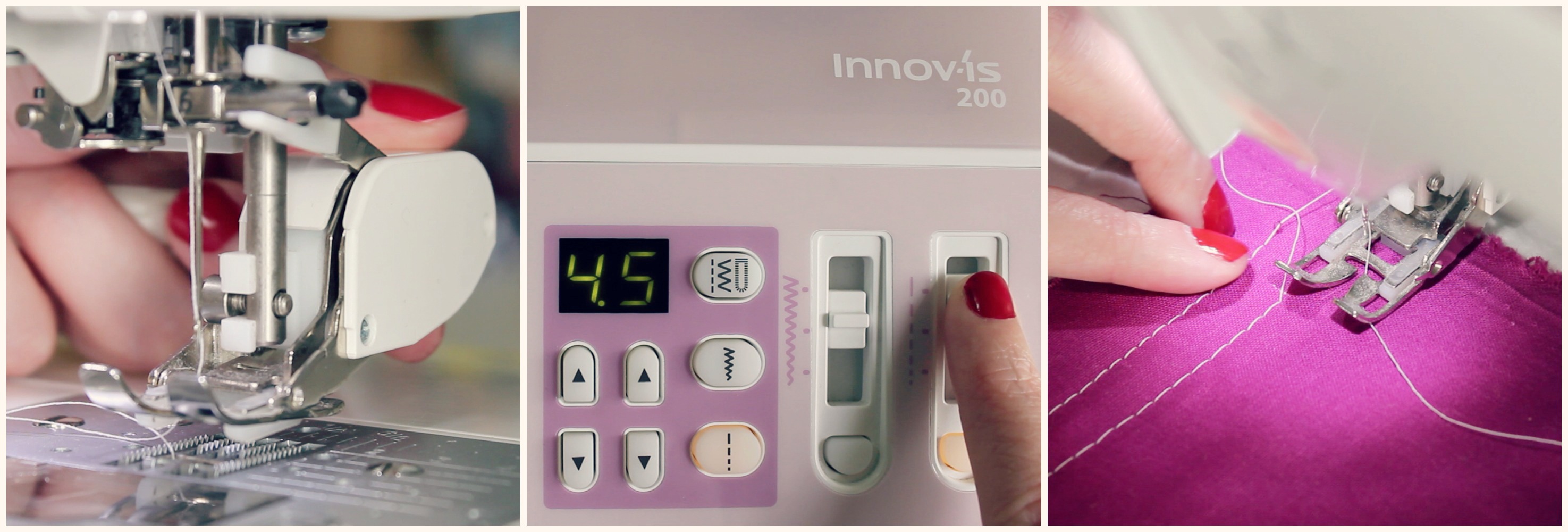
– The last thing I do to my machine is change the stitch length from 2.5 to 4.5. I find that when using a longer stitch length the machine feeds it through faster thus getting the quilt quilted faster! I also love how the long stitches leave this beautiful tactile surface effect making the quilt look fresh, modern and insanely mesmerising!
To test out what the stitch length will look like on your quilt, place a scrap piece of fabric along one edge of the quilt and sew lines at different lengths until you find the one that looks the best! Note the stitch length down and always remember to set it back to that every time you turn the machine back on! (If you have one of those really fancy sewing machines, program the stitch length in so that it’s easier to come back to!)
Setting up the the space around you:
– Make sure where you’ve set up is comfortable, spacey and has good light.
– Choose a comfortable chair that supports your back and allows you to be front-on with your sewing machine.
– Have essential tools beside you like thread snips, extra thread for the bobbin, water and some snacks if you really need them! I also like to have my phone close by incase I want to take some Instagram photos!
– Lastly, put on some good music, a movie, audio book or podcast to help you get into ‘the zone’!
My quilting technique:
– Before I start quilting, I make sure the surface of the quilt along with the batting and batting layers are lying flat, with no immediate tucks, folds or chances of puckering.
– I sew the first quilting line through the centre on the quilt, ditch-stitching along the seam of the middle sashing strip. This line will become my marker or guide to follow as I sew the rest of the lines.
– Beginning from the top edge, I gently feed the quilt through positioning my hands on top of the quilt at either side of the needle and walking foot, keeping the layers taut as they are fed through.
– I allow the sewing machine to feed the quilt through at it’s own pace. Don’t push or force the quilt through as this may result in skipped stitches, puckering and fabric shifting.
– Placing an extension table alongside your machine will help to control and feed through the quilt.
– Have the quilt hang into your lap as you feed it through to prevent the quilt from dragging and placing strain on you and your machine. Allowing the heavy weight of your quilt hang from your machine may result in skipped stitches and wonky quilting lines.
– To help ease the trouble you may have with the quilt hanging down from your left side, place a chair or ironing board along this side to prop up the quilt, easing the strain placed on you and your machine.
– If you’re quilting straight vertical lines, place the edge of the walking foot alongside the previous line you’ve just sewn and use it as a guide. If you want to make the space between your lines wider, insert a quilting guide-bar into the back of the walking foot, set it to the width you wish to use and place the bar alongside the previous line instead.
– Most importantly: take your time! Be patient with the process and always learn from the mistakes you make! (Remember: it’s okay to make mistakes! They make us better at what we do, even though you don’t think so at the time!!)
+++
So I think that’s everything I wanted to share with you in regards to quilting!
If you think I’ve missed a crucial step or if there’s a technique or way you love most to do, comment below and share your knowledge with us!
Don’t forget to keep sharing photos of your fabric choices, finished blocks and quilts if you’re following along with the series! I absolutely love seeing what you’re making and how you’re interpreting the pattern!! You’re all so wonderfully creative!! You can easily tag me on Instagram and Twitter using the handle: @3and3quarters or you can simply upload a picture to my Facebook page!
I hope that you’ll join me soon for part five where I’ll be teaching you how to make and attach a simple double binding to your quilt – the second last step to the finish line! Yay!!
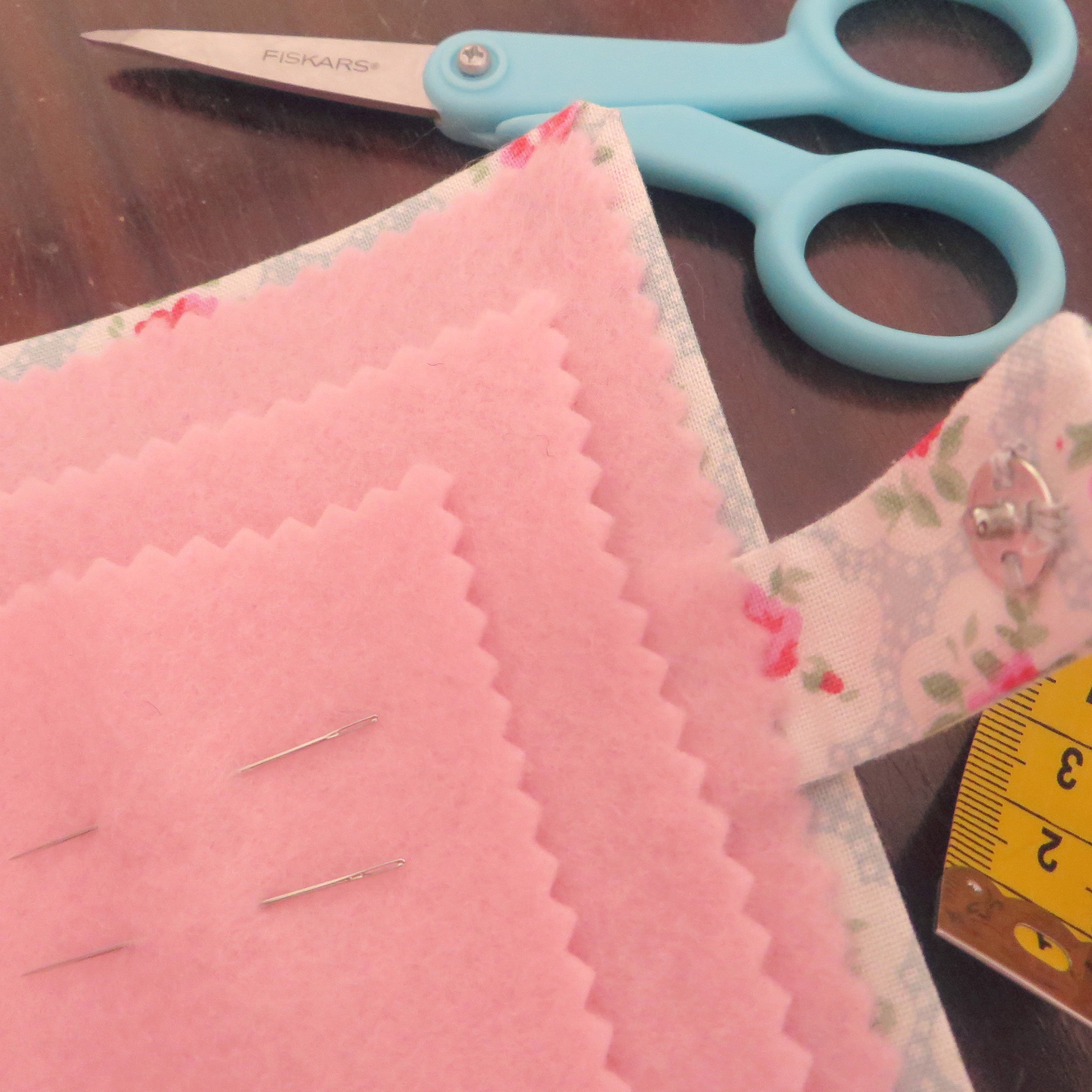
With needle packets lying all about my sewing room, some stuffed away in little drawers or packed into cutely decorated tins, I thought it was about time that I made a needlecase to house all of them in one place!
And course, if I was going to make one I just had to film it and show you how easy it is to make yourself!
So with my inspiration coming from this book: Sew! by Cath Kidston, I picked out a favourite fabric, some matching felt and all of the other materials and notions I would need to make my needlecase!
This is how I did it…
Here are the measurement and cutting details you’ll need…
For the OUTER COVER you will need: – x1: 9″x6″ rectangle of fabric* – x1: 9″x6″ rectangle of HeatnBond/Vliesofix/Bondaweb – x1: 8″x5″ rectangle of thin/lightweight cardboard – I used a green scrap piece as I didn’t have any white left! (*You can very easily use a Fat Quarter to make this project!)
For the TAB you will need: – x2: 1&1/4″x2&1/4″ rectangles of fabric (the same used on the outer cover) – x1: 1&1/4″x2&1/4″ rectangle of lightweight iron-on interfacing
For the FELT PAGES you will need: – x1: 4&3/4″x7&3/4″ rectangle* – x1: 4&3/4″x7&3/4″ rectangle of HeatnBond/Vliesofix/Bondaweb – x1: 4″x7″ rectangle – x1: 3″x6″ rectangle (*I was able to cut all three rectangles from one A4 piece of felt.)
And now the list of additional items you’ll also need…
– x1: 11mm snap fastener/stud – Hand sewing needle and matching thread – Sewing Machine (with matching thread as well) – Rotary blade, ruler and mat – Pinking Shears – Fabric and craft scissors – Thread snips – Iron
+++
Don’t forget to share with me your finished needlecases! Tag me on Instagram at @3and3quarters or share it on my Facebook page!
If you have any questions about this tutorial or have any future tutorial requests, comment below and we can have a good ol’ chat about it!
The other day, I was looking for a challenge… A block, that I’ve never before constructed, was a bit cutesy in design and was a possible candidate for a future block tutorial.
In there was this block: the Dollhouse. A sweet little House on the Prairie type design, that immediately ticked off all the boxes in my head.
As I was making it, I really wanted to share my honest thoughts and experiences about how the block came together…
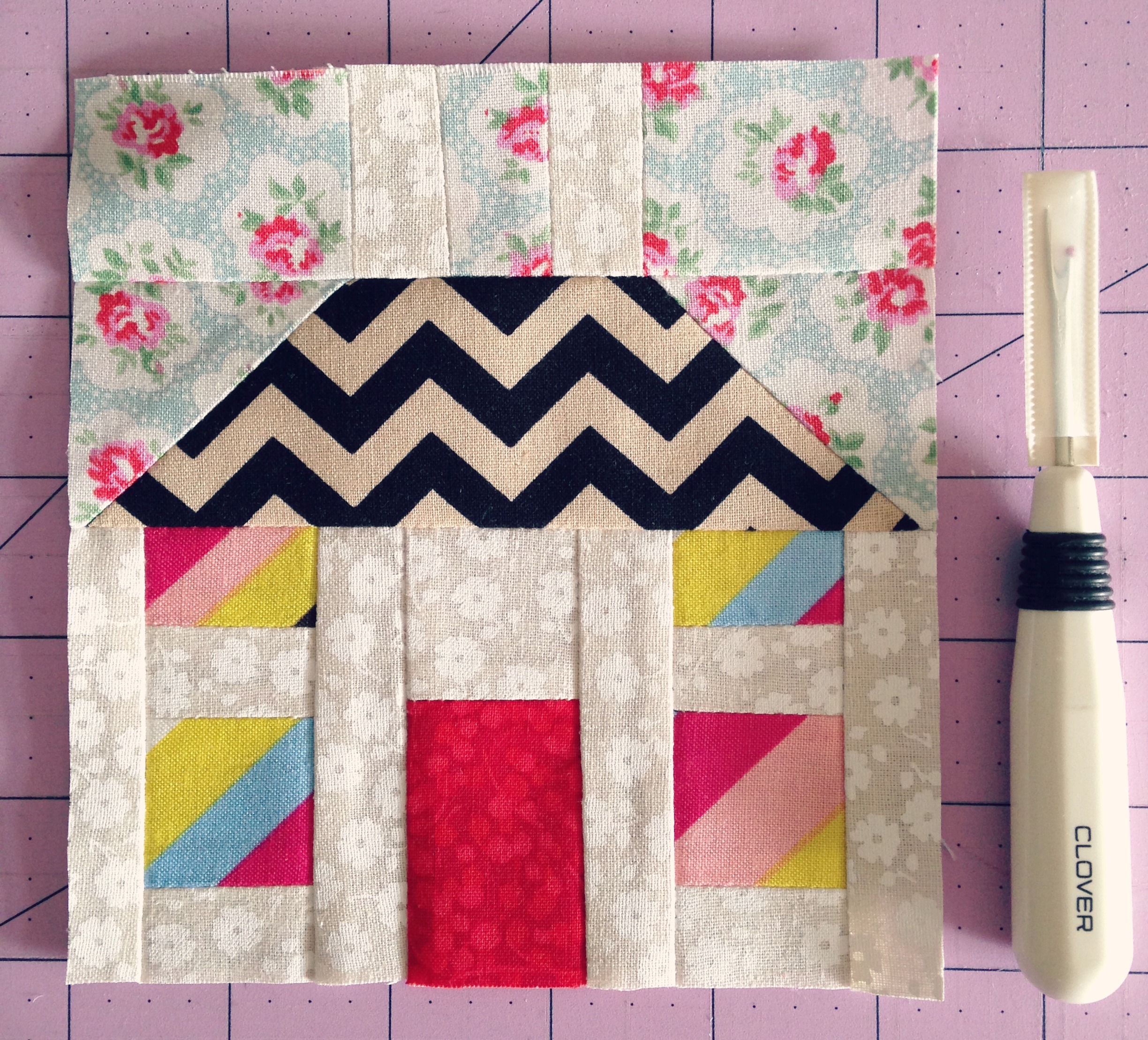
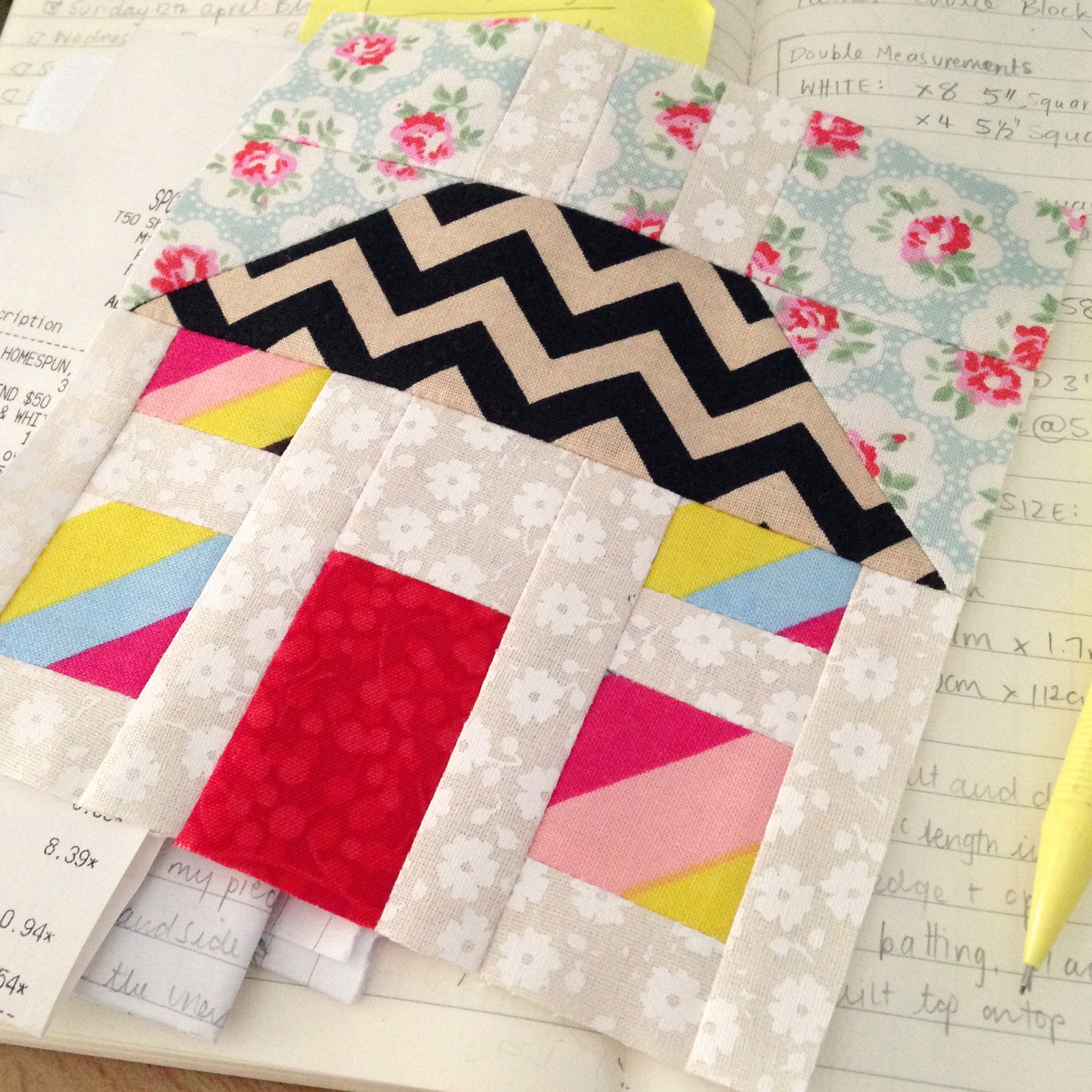
So here is my honest review of the Mini Dollhouse Block.
Because it’s a mini block, I knew that the measuring and cutting would be intricate and that I would have to be patient with it. There are a lot of different little pieces that make that up this block which requires quite a bit of concentration to keep track of everything you’re cutting and where it should go.
I did find that a few of the measurements seemed a little bit off. But I trusted the pattern and cut my fabrics according to what was published after checking back several times! At the time, the pieces that seemed a little odd in size included the square-triangles that were to be pieced to either end of the roof piece and the length of the two chimney strips.
When I began piecing, I first started with the bottom half of the house, joining together the windows, walls and door. I had no issue with these until it came time to adding on the four vertical 1″ strips separating the window and door strips. Although the length of these strips fit perfectly with the door strip, the window strips were too short, leaving a gap of about half an inch. ‘No problem’, I thought, as I would just simply trim the bottom edge so that it was even with the length of the window strips.
Moving on to making the roof, I had issues understanding how two 2&1/2″ squares were to be stitched diagonally on either side of a 2″x5&1/2″ rectangle. So I decided to cut the two squares down to 2″, drew a line through the middle of each and sewed them onto the ends of the rectangle roof piece. After trimming off the excess fabric from each end (the seam was cut to a 1/4″ allowance) and giving the section a good steamy press, I then attached the roof to the top of the house section. These two parts came together seamlessly and had very little over hang.
The part where I had the most difficulty was matching up the two chimney strips with the top edge corners of the roof. After piecing the allocated pieces together, I realised the centre square separating the two chimney strips was about half an inch too wide! So out came my trusty seam ripper and I patiently picked the two seams on either side of the square apart. (Remember, these pieces are super tiny, so my big fat fumbling fingers got in the way very easily!) I made the decision to cut a 1/4″ off from either side of the square, thus getting rid of the perforated surface that the stitching tension had caused and proceeded to try again. Success! Even though the pattern said to cut one 1&1/2″ square for this section, it ended up only needing a 1″x1&1/2″ strip.
So once I trimmed and squared off the edges, the finished block came to a size of 5&1/4″x5&5/8″ compared to the size of 5″ squared as stated in the book.
So that was my journey in making this block.
Now I must state, that everything I’ve written in this post is my own opinion. I simply wanted to document my experiences, triumphs, failures and the thought process behind this block as it was taking shape.
As I was writing this, I was conscience of not sounding too harsh or judgemental over the pattern being published slightly wrong. (Who knows, maybe it was just me getting things wrong…?) But to be completely honest, I was a little bit disappointed by it as this is the first block in this book to let me down! And that’s a real shame because the endless possibilities of creativity behind this patchwork book is brilliant! But I guess it’s also important to remember that not everything can be perfect. Mistakes happen. Information can be misplaced and be so easily entered in wrong. Perhaps that’s what’s happened in this case…?
So sometime very soon I will re-make this block using the measurements that I found worked out better as well as picking out a range of fabrics that go together a lot nicer in comparison to the block above. And once I’m happy with that, I’ll more than likely create a tutorial showing you how to make it!











 3and3quarters